> ## Documentation Index
> Fetch the complete documentation index at: https://docs.supermisson.fun/llms.txt
> Use this file to discover all available pages before exploring further.
# How Prediction Markets Work
> Binary outcomes, shares that pay $1 or $0, and prices that reflect what the crowd actually believes. The mechanics in 3 minutes.
# Prediction markets — first principles
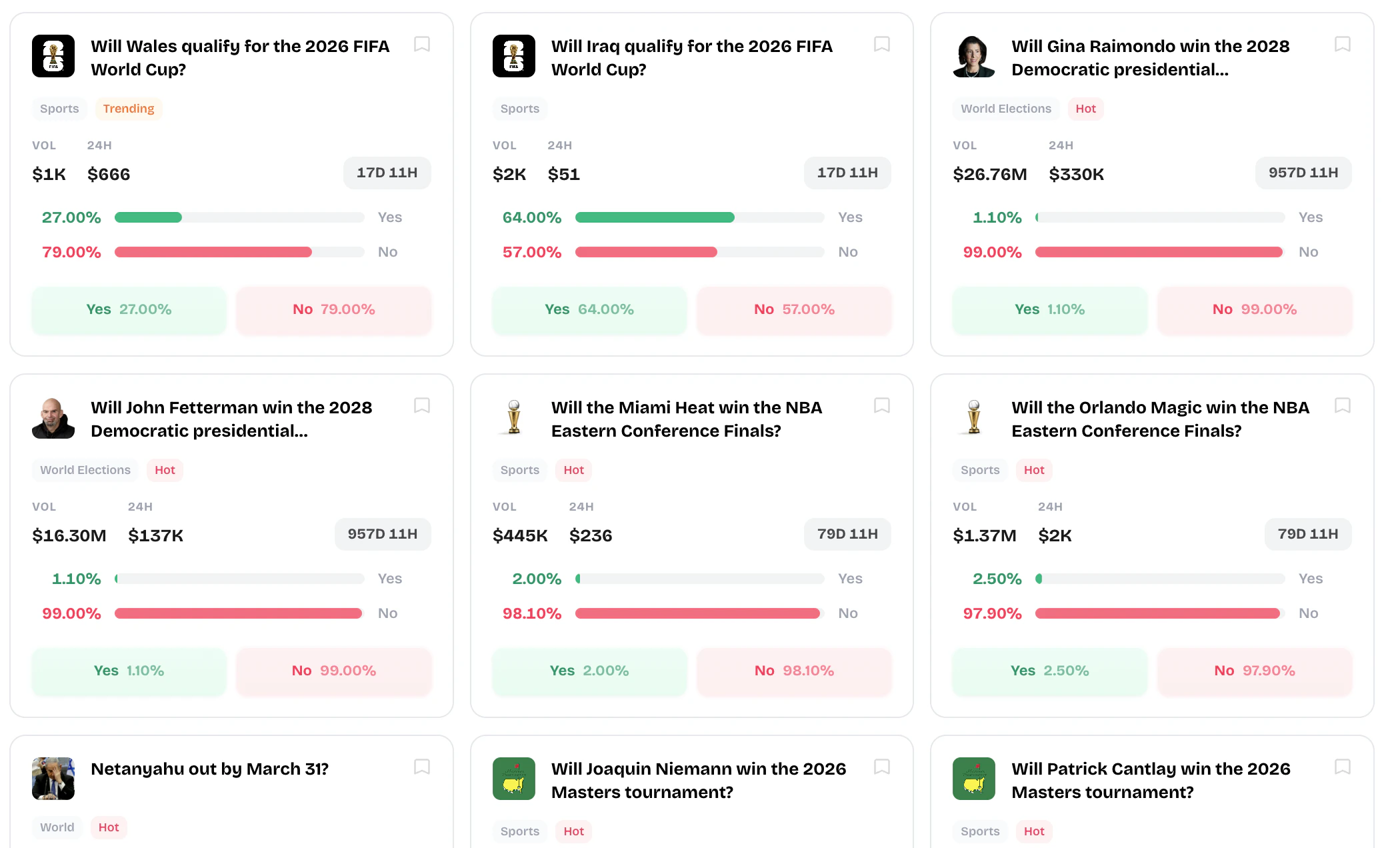 A prediction market is a market where you trade on the outcome of real-world events. Will X happen? The market gives you a price, and that price is the crowd's probability estimate.
That's it. Everything else is mechanics.
## The core mechanic
Every market has two outcomes: **YES** and **NO**.
* A YES share pays `$1.00` if the event happens, `$0.00` if it doesn't
* A NO share pays `$1.00` if the event doesn't happen, `$0.00` if it does
* YES price + NO price always sums to approximately `$1.00`
If YES is trading at `$0.65`, the market is saying: "we collectively believe there's a 65% chance this happens."
Market: "Will BTC hit `$100K` by June?"
YES price: `$0.30` (market says 30% chance)
You think it's more like 60%. So you buy YES at `$0.30`.
* **If right**: each share pays `$1.00`. You profit **`$0.70` per share** (233% return)
* **If wrong**: each share pays `$0.00`. You lose **`$0.30` per share**
The asymmetry is the whole game. Low prices = high upside if you're right.
Market: "Will the Fed cut rates in March?"
YES price: `$0.80` (market says 80% chance)
You think it's overhyped. So you buy NO at `$0.20`.
* **If right**: each share pays `$1.00`. You profit **`$0.80` per share** (400% return)
* **If wrong**: each share pays `$0.00`. You lose **`$0.20` per share**
Fading the consensus can be the highest-edge play — when you're right.
## How markets resolve
Every market has a **resolution source** — the objective criteria that determines the outcome. Most Polymarket markets use the **UMA Optimistic Oracle**, which works like this:
1. An event happens (or doesn't)
2. Someone proposes a resolution (YES or NO)
3. There's a challenge period where anyone can dispute
4. If undisputed, the resolution is finalized
5. Winning shares become redeemable for `$1.00`
Resolution is based on objective, verifiable criteria defined when the market is created. It's not opinion-based — it's "did this specific thing happen or not?"
## Where the edge comes from
Markets are efficient, but not perfectly efficient. Your edge exists when:
* **You have information the market hasn't priced in** — breaking news, domain expertise, pattern recognition
* **The market is reacting emotionally** — panic selling or hype buying creates mispricings
* **Time decay is mispriced** — a market expiring tomorrow has very different dynamics than one expiring in 3 months
* **Liquidity is thin** — small markets can be significantly mispriced because not enough smart money is paying attention
This is exactly what Supermission's AI agents look for. They cross-reference news, sentiment, and historical patterns to find markets where the price doesn't match reality.
The best trades aren't "I think YES." They're "the market says 30%, I have specific reasons to believe it's 60%, and here's why the crowd is wrong."
A prediction market is a market where you trade on the outcome of real-world events. Will X happen? The market gives you a price, and that price is the crowd's probability estimate.
That's it. Everything else is mechanics.
## The core mechanic
Every market has two outcomes: **YES** and **NO**.
* A YES share pays `$1.00` if the event happens, `$0.00` if it doesn't
* A NO share pays `$1.00` if the event doesn't happen, `$0.00` if it does
* YES price + NO price always sums to approximately `$1.00`
If YES is trading at `$0.65`, the market is saying: "we collectively believe there's a 65% chance this happens."
Market: "Will BTC hit `$100K` by June?"
YES price: `$0.30` (market says 30% chance)
You think it's more like 60%. So you buy YES at `$0.30`.
* **If right**: each share pays `$1.00`. You profit **`$0.70` per share** (233% return)
* **If wrong**: each share pays `$0.00`. You lose **`$0.30` per share**
The asymmetry is the whole game. Low prices = high upside if you're right.
Market: "Will the Fed cut rates in March?"
YES price: `$0.80` (market says 80% chance)
You think it's overhyped. So you buy NO at `$0.20`.
* **If right**: each share pays `$1.00`. You profit **`$0.80` per share** (400% return)
* **If wrong**: each share pays `$0.00`. You lose **`$0.20` per share**
Fading the consensus can be the highest-edge play — when you're right.
## How markets resolve
Every market has a **resolution source** — the objective criteria that determines the outcome. Most Polymarket markets use the **UMA Optimistic Oracle**, which works like this:
1. An event happens (or doesn't)
2. Someone proposes a resolution (YES or NO)
3. There's a challenge period where anyone can dispute
4. If undisputed, the resolution is finalized
5. Winning shares become redeemable for `$1.00`
Resolution is based on objective, verifiable criteria defined when the market is created. It's not opinion-based — it's "did this specific thing happen or not?"
## Where the edge comes from
Markets are efficient, but not perfectly efficient. Your edge exists when:
* **You have information the market hasn't priced in** — breaking news, domain expertise, pattern recognition
* **The market is reacting emotionally** — panic selling or hype buying creates mispricings
* **Time decay is mispriced** — a market expiring tomorrow has very different dynamics than one expiring in 3 months
* **Liquidity is thin** — small markets can be significantly mispriced because not enough smart money is paying attention
This is exactly what Supermission's AI agents look for. They cross-reference news, sentiment, and historical patterns to find markets where the price doesn't match reality.
The best trades aren't "I think YES." They're "the market says 30%, I have specific reasons to believe it's 60%, and here's why the crowd is wrong."